

Setup Tips: Optimizing Line Arrays and Point Source Speakers
- line array vs point source speakers: Quick overview and setup goals
- line array vs point source speakers: Fundamental differences
- line array vs point source speakers: Coverage, throw, and audience experience
- line array vs point source speakers: Practical setup checklist
- line array vs point source speakers: Acoustic environment and placement tips
- line array vs point source speakers: System tuning and processing
- line array vs point source speakers: Hands-on deployment — step-by-step
- line array vs point source speakers: Comparison table
- line array vs point source speakers: Common mistakes and troubleshooting
- line array vs point source speakers: Power, cabling, and logistical tips
- line array vs point source speakers: Why T.I Audio can help (brand and product fit)
- line array vs point source speakers: Example real-world deployments
- line array vs point source speakers: Quick checklist before opening doors
- line array vs point source speakers: Frequently Asked Questions (FAQ)
- Contact T.I Audio / See products
- References and sources
line array vs point source speakers: Quick overview and setup goals
Choosing between line arrays and point source speakers and setting them up correctly are two of the most common challenges in pro audio. Whether you are designing sound for a concert, house of worship, wedding, club, or outdoor festival, the decision affects coverage, intelligibility, and audience experience. This article compares line array vs point source speakers, explains when to use each, and gives actionable setup and tuning tips you can apply today.
line array vs point source speakers: Fundamental differences
At a basic level, a point source speaker radiates sound from a single enclosure. It behaves much like a discrete loudspeaker where dispersion and SPL drop off follow conventional spherical spreading. In contrast, a line array is a series of identical elements arranged vertically to form a coherent radiating line. This creates a cylindrical wavefront in the near field and enables more constant SPL over distance in the main coverage area.
Key practical takeaways:
- Line arrays: better long-throw control, more even SPL across audience depth, optimized for large venues and stadiums.
- Point source: simpler setup, better near-field performance, often preferred for small to medium venues or where true point coverage is desired.
line array vs point source speakers: Coverage, throw, and audience experience
When planning coverage, ask: How far does sound need to travel? How wide must the audience area be? How important is uniformity of level across zones? Line arrays allow designers to shape vertical coverage precisely by varying array length and splay angles between cabinets. Point source arrays (clusters of point sources or multiple stacks) can provide wide horizontal dispersion and excellent direct sound in small to medium rooms.
Common venue choices:
- Large arenas, outdoor festivals, stadiums: Line arrays because of controlled vertical dispersion and distance performance.
- Small theaters, clubs, houses of worship, smaller rental gigs: Point source systems often deliver better clarity and are faster to deploy.
line array vs point source speakers: Practical setup checklist
Before powering up, follow a consistent checklist to avoid common mistakes that degrade performance:
- Define target SPL and maximum allowed variance across listening areas (for example, ±3 dB).
- Map the audience area and mark the front, middle, and rear listening positions.
- For line arrays: calculate required array length, pick appropriate splay angles, and pre-plan flown rigging points and ground-stacks if needed.
- For point source: select speaker positions to achieve even overlap, use delays for fill speakers to align arrival time, and choose wedges/monitors for on-stage needs.
- Ensure safety: rigging load checks for flown arrays and correct mechanical support for ground-stacked systems.
line array vs point source speakers: Acoustic environment and placement tips
Room acoustics play a major role in perceived performance. Here are actionable tips:
- Avoid pointing high-energy low-mid content directly at reflective surfaces (walls, ceilings, balconies). For line arrays this is easier due to steerability; for point sources, use time alignment and EQ to reduce problematic resonances.
- Use cardioid subs or flown sub coverage to minimize stage and rear-wall bass buildup. Sub placement affects clarity dramatically.
- For noisy outdoor stages with audience areas under a stage roof, raise the array height to clear the roof edge and avoid near-field cancellations.
line array vs point source speakers: System tuning and processing
Modern systems rely on DSP to reach their potential. Processing tips that apply to both system types:
- Start with manufacturer-prescribed presets but verify in-situ and modify for the room.
- Use delay alignment between main PA and outfills/fills to maintain coherency; measure time-of-arrival differences with a measurement mic and correct them in milliseconds.
- Implement gentle, broad EQ changes rather than deep surgical cuts when possible; use parametric filters to tame resonances identified in measurements.
- For line arrays, use array-curves or wavefront-synthesis tools provided by the manufacturer to simulate and export splay and processing settings.
line array vs point source speakers: Hands-on deployment — step-by-step
Step-by-step approach for a reliable deployment:
- Pre-plot: Model the venue with array-design software (if available) to set preliminary flown angles and rigging parameters.
- Mechanical rigging: Install the flown points and check load cells and safety lines. For ground stacks, secure all cabinets and use proper stacking hardware.
- Measurement sweep: With mains at low level, take a reference measurement at front-center. Walk to representative points (front, middle, rear) and note level variance and major resonances.
- Time-align fills: Set delays so direct sound from mains and fills arrives within a few milliseconds of each other at target seats.
- EQ and gain structure: Use pink noise to set system gain, then adjust EQ to get the target tonal balance. Re-measure and iterate.
line array vs point source speakers: Comparison table
| Attribute | Line Array | Point Source |
|---|---|---|
| Primary strength | Controlled vertical dispersion, even SPL over distance | Simplicity, strong near-field directivity |
| Best for | Large venues, festivals, arenas | Small-to-medium venues, clubs, theaters |
| Setup complexity | Higher — rigging, splay angles, advanced DSP | Lower — faster deploy, intuitive placement |
| Coverage control | High — steerable and sectioned | Moderate — requires multiple cabinets and delays for long throw |
| Cost (system-level) | Typically higher upfront for full array systems | Typically lower for comparable venue coverage |
Sources for the comparison above include manufacturer whitepapers and industry handbooks listed at the end of the article.
line array vs point source speakers: Common mistakes and troubleshooting
Typical issues and quick fixes:
- Uneven SPL front-to-back: For arrays, check splay angles and array length; increase array length or change droop to improve rear coverage. For point source, add delay towers or outfills and time-align them.
- Harshness or strident highs: Reduce high-mid Q peaks identified in measurements; check for over-coverage causing comb filtering.
- Boomy low end: Revisit sub placement and crossover points. Consider cardioid sub arrangements to reduce stage and rear reflections.
- Poor intelligibility: Lower reverb tail in the room (acoustic treatment if possible), focus on mid-range clarity through targeted EQ and IR/processor predelay adjustments.
line array vs point source speakers: Power, cabling, and logistical tips
Operational tips to keep rigging efficient and reliable:
- Label all cables and use color-coded snakes for quick troubleshooting.
- Plan amplifier allocation with some headroom; avoid pushing amps into thermal protection territory.
- Keep spare cabinet and flyware parts, and an extra DSP/amp channel for redundancy on critical events.
- For touring rigs, invest in consistent rigging frames and flight cases to speed setup and teardown.
line array vs point source speakers: Why T.I Audio can help (brand and product fit)
When choosing or renting equipment, working with a reliable manufacturer and supplier makes the difference between a technically correct deployment and a great sounding show. T.I Audio, a leading pro audio manufacturer with 14 years' experience in China, offers a broad product range relevant to both system types: line arrays, PA speakers, stage monitors, subwoofers, power amplifiers, active line arrays, active speakers, processors, digital mixers, and wireless microphones.
T.I Audio core strengths for implementing line array vs point source speakers solutions:
- Manufacturing capacity: 100 production line staff, over 10,000 sqm of factory space ensuring consistent build quality.
- R&D expertise: An 8-person engineering team with over 20 years of experience designing pro audio systems, which helps optimize array behavior and tuning presets.
- Global sales and support: 50 international salespeople, branches in 10 countries, and products sold in more than 100 countries and regions — helpful for logistics and local support.
- Product suitability: Systems designed for live shows, concerts, church crusades, weddings, large-scale music festivals, KTV, clubs, sound rental shows, indoor and outdoor events, and government conferences.
By combining well-engineered line arrays and point source options, T.I Audio provides turnkey choices for rental houses and venues where flexibility is key. Their active line arrays and processors come with manufacturer-presets that accelerate setup while preserving the ability to fine-tune on-site.
line array vs point source speakers: Example real-world deployments
Two common deployment patterns:
1) Large outdoor festival — line array primary, point source fills: A flown T.I Audio line array covers the main audience footprint. Delayed point source stacks are placed mid-field as delay towers to maintain coherence and increase SPL uniformity. Cardioid subs under the stage reduce stage wash and improve FOH clarity.
2) Medium theater — point source mains, small flown fills: Point source mains near stage lip provide excellent near-field clarity and stage-to-audience intimacy. Small flown line-array-style clusters or compact line arrays can be used for balcony coverage if needed, with precise delay and EQ tuning.
line array vs point source speakers: Quick checklist before opening doors
- Verify mechanical rigging and safety factors (2x to 12x depending on local codes and equipment).
- Confirm amplifier and DSP mapping match the planned crossover and delays.
- Run a soundcheck with music and speech material representative of the event, then measure and refine.
- Document final settings (levels, delay offsets, EQ) for consistent repeatability on subsequent events.
line array vs point source speakers: Frequently Asked Questions (FAQ)
Q1: Which is better for my church — line array or point source?
A: For small to mid-size churches, point source systems often provide natural speech intelligibility and simpler setup. For larger auditoriums or multiple-tier seating, a line array can provide more even coverage and consistent SPL over greater distances.
Q2: Can I mix line arrays and point source speakers?
A: Yes — many venues use a flown line array for the main zone and point source clusters or delay stacks for side-fill and rear-fill. Proper delay alignment and EQ are essential to avoid comb filtering.
Q3: How do I choose array length and splay angles?
A: Use array-design software or manufacturer guidelines. The required vertical coverage and audience depth determine array length; splay angles are tuned to overlap coverage smoothly from top to bottom of the audience area.
Q4: Do line arrays need more DSP than point sources?
A: Typically, yes. Line arrays benefit from wavefront control, array presets, and precise delays. Point source systems still require DSP (crossovers, EQ, delay) but often need fewer complex spatial calculations.
Q5: What common measurement tool should I use?
A: A real-time analyzer (RTA) with calibrated measurement mic (e.g., Earthworks or Behringer measurement mics for budget tests) plus software like Smaart, REW, or manufacturer-provided tools will let you measure SPL, phase, and impulse response for alignment and tuning.
Contact T.I Audio / See products
If you want help choosing or deploying the right system, T.I Audio provides both products and technical support. Explore product lines or contact sales at T.I Audio: https://www.ti-audio.com/. We are recruiting dealers worldwide and can support design, manufacturing, and after-sales service for your next project.
References and sources
- Meyer Sound, Line Array Fundamentals and technical resources on array behavior.
- d&b audiotechnik whitepapers and system engineering resources on line array design.
- Sound Reinforcement Handbook, Gary Davis & Ralph Jones — foundational guidance on loudspeaker placement and tuning.
- Shure technical articles on loudspeaker types and deployment best practices.
- Yamaha Pro Audio product notes and application guides on speaker placement and delay usage.
Note: Manufacturer-specific presets, rigging data, and software tools should be consulted for exact array parameters before rigging and tuning. For venue-specific advice, consider a pre-event site survey and on-site measurement session.
T.i Audio best professional subwoofer dj speakers Manufacturers and supplier brand in China
Everything You Need to Know About two 15 inch subwoofer box
OEM/ODM neodymium speakerprivate label Manufacturers and supplier in China
How to Choose Right pro studio dual 15 inch speakers manufacturer and supplier?
Company
Are you factory or trade company?
Yes, my friend. You are buying from our factory directly at the factory price.
T.I Audio,a leading pro audio manufacturer brand in China for 14 years,.
We have been selling to more than 100 countries in the world.
Customization
Are you provide customize packaging?
Yes, we accept custom packaging orders.
What is your fast production delivery?
We usually need 15-20 working days for delivery time, but if you have any special or confirmed orders today, I will try to apply for a top urgent order with a faster delivery time for you, my friend.
What color options do you offer?
We support customized services. Customers in your country tend to prefer black-line array systems. Of course, we can also make them black, white, or red. We just hope you can buy a product you are satisfied with.
Payment
Do you accept L/C payment
No, we are T/T or Alibaba only.

T.I Pro Audio waterproof passive dual 15 inch best line array speakers (max215)
MAX215 was born for big outdoor events, such as concerts, church, crusades, etc. With its 100% waterproof design, it can be used in strong sunlight or heavy rain without worrying about any safety problems. Max215 with LF: 2*ND15 driver MF: 2 *ND10'' Neodymium drivers; HF: 2 *ND3” Neodymium drivers. It can cover more than 5,000 people. This product was very popular after its launch because of its unique, patented appearance and perfect sound. And quickly occupy market share. Help large projects get powerful and perfect sounds.
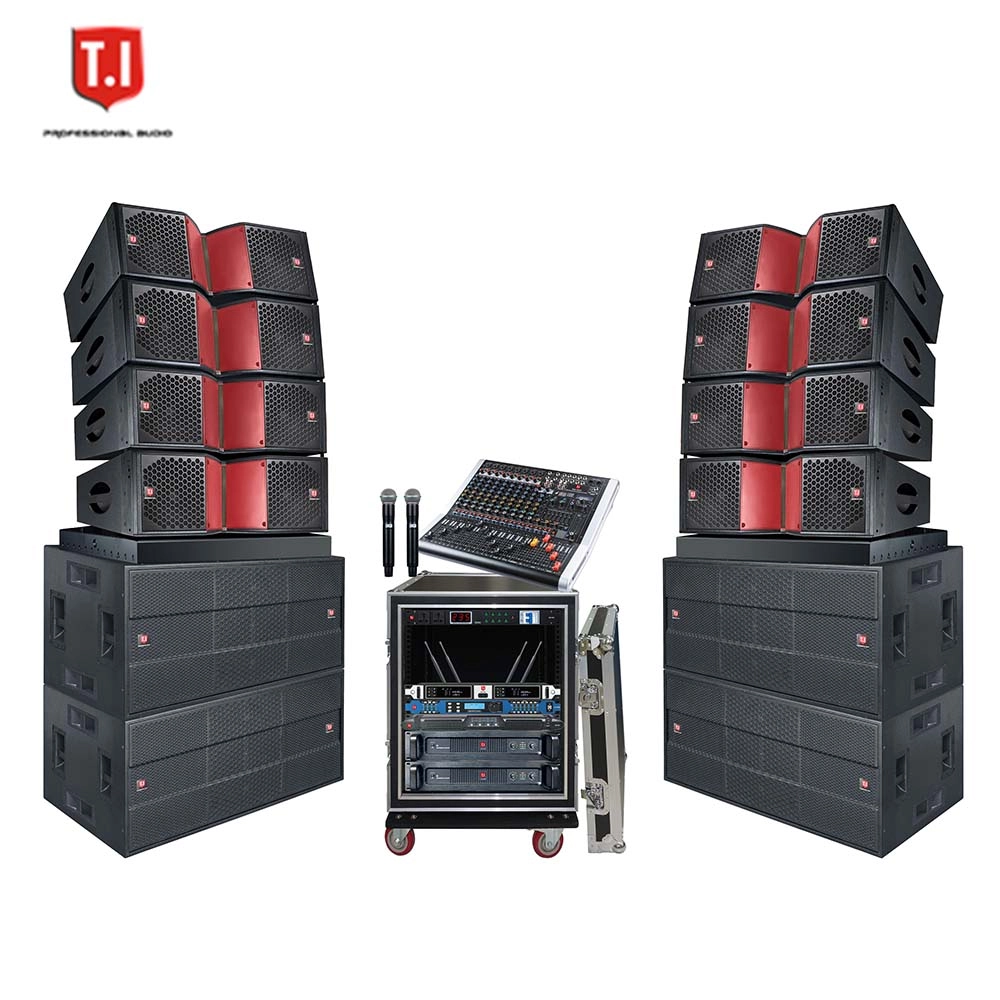
T.I Pro Audio new design waterproof linear array speakers dual 12-inch live sound outdoor concert speaker
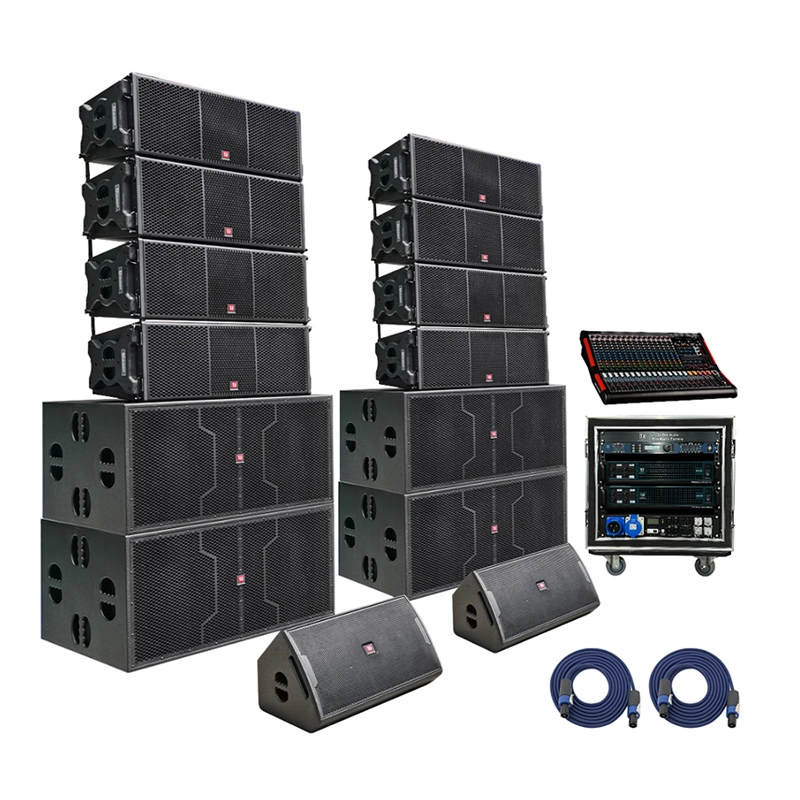
T.I Pro Audio Waterproof Passive Dual 12 Inch Two Way Powered Line Array Speakers For Church (LA-2122)
LA-2122 uses a neodymium unit to ensure its high sensitivity, small size and light weight.The surface is black, high-strength polyurea paint.The 134dB maximum sound pressure level output makes LA-2122 stress-free in medium- and large-scale mobile performance applications.
 Scan QR Code
T.IProAudioFactory
t.i_audio
T.I Pro Audio
Lisa Han
t.i_audio